Dholera Smart City Utilities: The Infrastructure Under the Ground
Verified FreshUpdated 13 Sept 2026· 6 min read
Quick answer
Dholera's smart-city utilities are concentrated in its Activation Area, the roughly 22.5 sq km plug-and-play demonstration zone. According to a DICDL account from 2024, the built infrastructure there includes underground utilities for power, ICT and fibre, piped natural gas and potable water, a recycled-water network, and stormwater routed into a 6.5 km man-made canal. It also includes a water treatment plant of about 50 MLD with reservoirs, roughly 72 km of internal roads from 18 to 70 metres wide with pedestrian and cycle lanes, and an Integrated Command and Control Centre in the ABCD building. Some widely marketed features, notably a common walkable utility tunnel and district cooling, are promotional or unverified and are flagged as such.
Dholera's smart-city utilities are concentrated in its Activation Area, the roughly 22.5 sq km plug-and-play demonstration zone. According to a DICDL account from 2024, the built infrastructure there includes underground utilities for power, ICT and fibre, piped natural gas and potable water, a recycled-water network, and stormwater routed into a 6.5 km man-made canal. It also includes a water treatment plant of about 50 MLD with reservoirs, roughly 72 km of internal roads from 18 to 70 metres wide with pedestrian and cycle lanes, and an Integrated Command and Control Centre in the ABCD building.
Some widely marketed features, notably a common walkable utility tunnel and district cooling, are promotional or unverified and are flagged as such.
Key facts
Where
Activation Area (~22.5 sq km)
Utilities
Underground power, ICT, gas, water
Stormwater canal
6.5 km man-made
Water plant
~50 MLD + reservoirs
Roads
~72 km, 18-70 m wide
Brain
ICCC in the ABCD building
Dholera's smart-city utilities are concentrated in the Activation Area, the roughly 22.5 sq km plug-and-play zone that serves as the region's phase-one demonstration. According to a DICDL account from 2024, the built infrastructure there includes underground power, ICT and gas ducts, piped and potable water, a recycled-water network, stormwater routed into a 6.5 km canal, a water treatment plant of about 50 MLD, roughly 72 km of internal roads, and an Integrated Command and Control Centre. This page details what is reported built, and clearly separates it from features that are only marketed or unverified.
The short answer
A smart city's defining feature is that its services are engineered as a system from the start, not retrofitted later. In Dholera, that system is furthest along in the Activation Area, where utilities run underground and a central control centre monitors them. The idea is plug-and-play: a plot buyer or a factory connects to ready trunk infrastructure rather than building it.
For the region this sits inside, see what Dholera SIR is.
~22.5
sq km Activation Area served
6.5 km
man-made stormwater canal
~50 MLD
water treatment capacity
~72 km
internal road network
Underground utilities
The most distinctive feature is that utilities are laid underground rather than on poles and open trenches. Per the DICDL account, the Activation Area carries underground ducts for power, ICT and fibre-optic cabling, piped natural gas, and potable water fitted with smart meters and leak detection. Burying these lines keeps streets clear of overhead wires, reduces weather and tampering risk, and makes maintenance a matter of accessing ducts rather than digging up roads each time.
Water and drainage
Water is engineered as a full cycle. Potable supply is drawn from a water treatment plant of about 50 MLD, meaning 50 million litres a day, backed by reservoirs. A separate recycled-water network carries treated water for non-drinking uses, which reduces demand on fresh supply, a meaningful design choice in a semi-arid coastal region.
Wastewater and industrial effluent run in their own lines to treatment rather than mixing with stormwater.
Drainage matters especially here because Dholera sits on flat, low-lying coastal Bhal land where flooding is a documented planning constraint. To handle heavy monsoon runoff, stormwater is channelled into a 6.5 km man-made canal that moves water out of the developed zone. Separating stormwater from sewage is standard good practice and is part of why the utilities are designed as distinct networks rather than a single combined system.
Utility
What is reported built
Figure
Water treatment
Plant plus reservoirs
~50 MLD
Recycled water
Separate reuse network
Built (Activation Area)
Stormwater
Routed to man-made canal
6.5 km canal
Roads
Internal network, 18-70 m wide, with cycle and pedestrian lanes
~72 km
Power / ICT / gas
Underground ducts
Built (Activation Area)
Control centre
ICCC in the ABCD building
Operational (reported)
Roads and mobility
The Activation Area has a reported internal road network of about 72 km, with widths ranging from 18 to 70 metres. The wider roads form the main spines; narrower roads serve internal blocks. The design includes dedicated pedestrian and cycle lanes and a reserved corridor for future rapid transit, so that a mass-transit line can be added without tearing up completed streets.
This is the same forward-provisioning logic that runs through the whole utility design: put the reservations and ducts in first, connect tenants later.
The ICCC: the city's brain
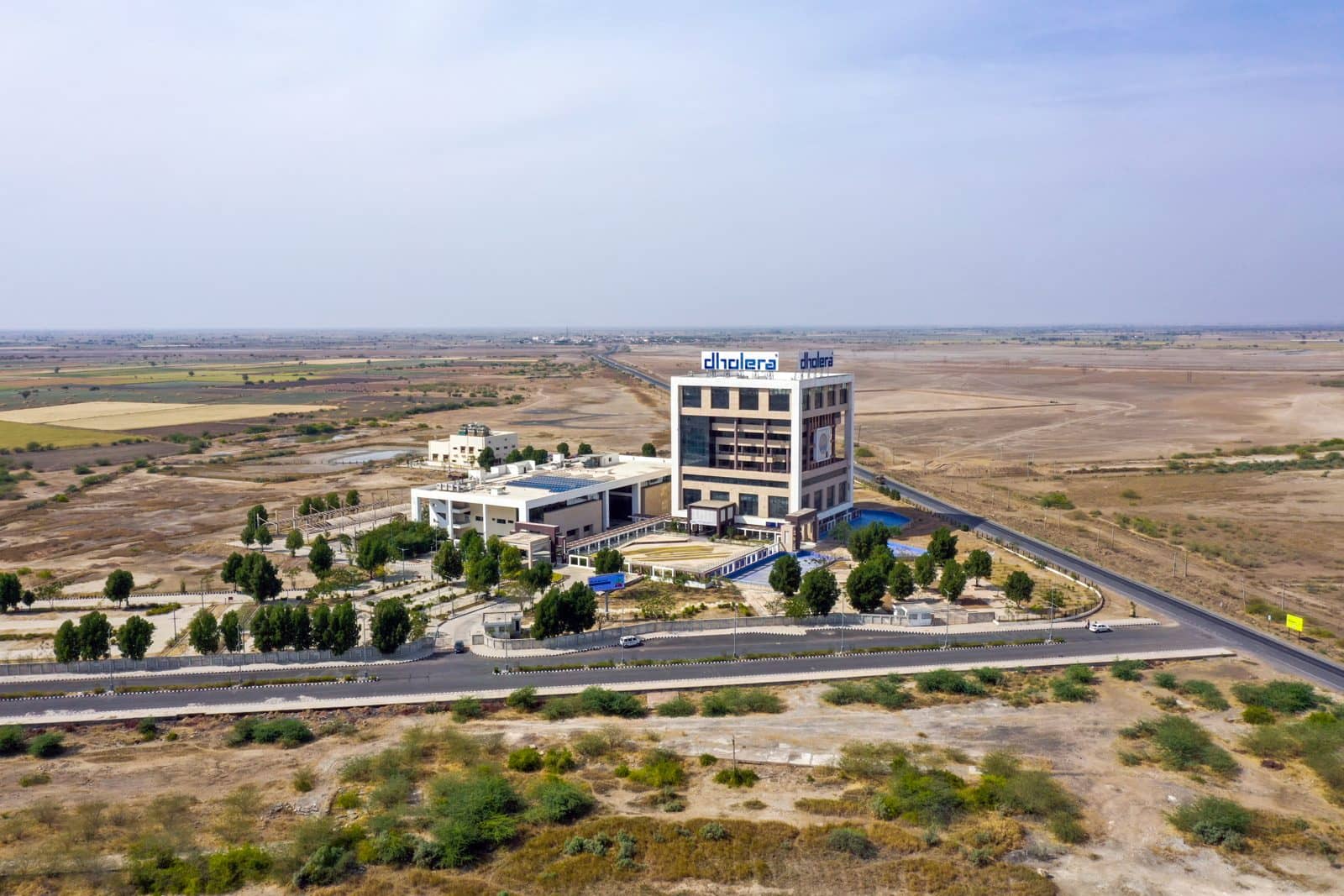
The nerve centre of the smart city is the Integrated Command and Control Centre, or ICCC, housed in the ABCD building. ABCD stands for Administrative cum Business Centre for Dholera, located in the TP2 Knowledge and IT Zone. The ICCC is designed to monitor and coordinate city systems in one place, including water, power, street lighting, surveillance, traffic, and environmental sensors, and the building also holds authority offices and single-window clearance functions.
It is reported as structurally complete and operational, though an exact inauguration date is not cleanly sourced.
What ICCC means in practice: instead of separate departments managing water, power and traffic in isolation, a command centre gives one integrated view. That is the core of what makes a city "smart" in the operational sense, as opposed to marketing.
What is marketed but not confirmed
Not every widely repeated feature is verified, and a neutral reference has to say so. Two promotional claims in particular should be treated with care.
Verify before you rely: the underground ducts, the 50 MLD plant, the 6.5 km canal, the ~72 km roads and the ICCC are reported built in the Activation Area. A common walkable utility tunnel and district cooling are unconfirmed. If a feature matters to your decision, confirm its current status from an official source rather than a brochure.
One more scope point is essential. Almost all of this infrastructure is inside the roughly 22.5 sq km Activation Area, which is a small fraction of the roughly 920 sq km planned region. The rest of Dholera is still farmland and future Town Planning schemes.
So when marketing describes Dholera as a fully wired smart city, the accurate reading is that the demonstration zone is built to that standard, and the wider region will follow in phases. For how this affects a purchase decision, see is Dholera safe to invest.
Frequently asked questions
What smart-city utilities does Dholera have?
Per a DICDL account from 2024, the Activation Area has underground utilities for power, ICT and fibre, piped natural gas and potable water with smart meters, a recycled-water network, separate wastewater and effluent lines, stormwater routed into a 6.5 km canal, a water treatment plant of about 50 MLD with reservoirs, roughly 72 km of internal roads, and an Integrated Command and Control Centre in the ABCD building.
What is the ICCC in Dholera?
The Integrated Command and Control Centre, housed in the ABCD building, is the smart city's central monitoring hub. It is designed to coordinate water, power, lighting, surveillance, traffic and environmental systems from one place, alongside authority offices and single-window clearance. It is reported as operational, though an exact inauguration date is not cleanly sourced.
How big is Dholera's water treatment plant?
The Activation Area is served by a water treatment plant of about 50 MLD, meaning 50 million litres a day, backed by reservoirs. A separate recycled-water network reuses treated water for non-drinking purposes to reduce demand on fresh supply.
Does Dholera have a walkable utility tunnel?
Underground utility ducting is confirmed, but a single common walkable utility tunnel is not officially confirmed and should be treated as promotional until verified. District cooling and lon