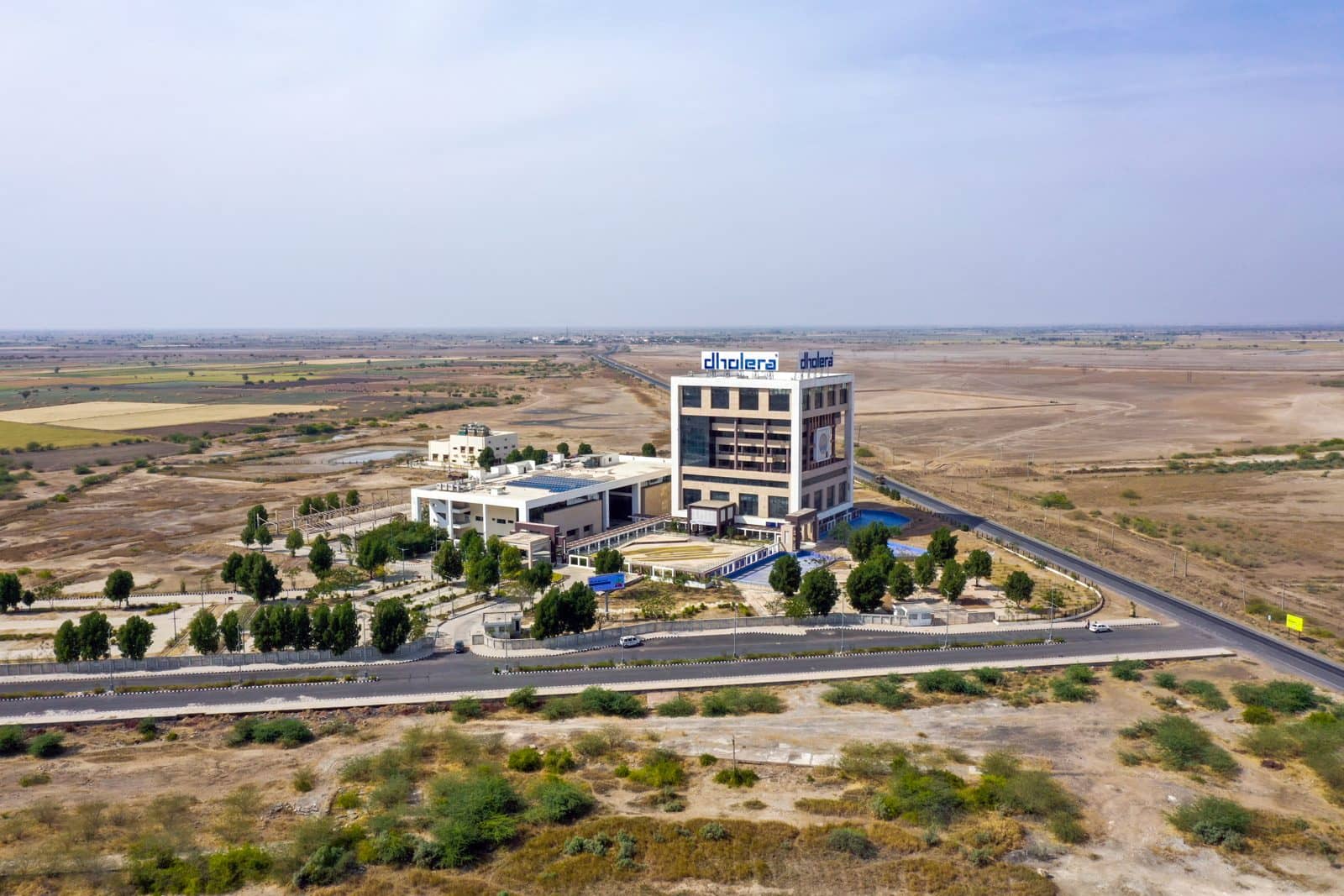
Dholera Industries and Sectors: What Will Be Built Here
Verified FreshUpdated 13 Sept 2026· 6 min read
Quick answer
Dholera SIR is planned as a multi-sector industrial city, not a single-industry town. Its official target sectors include defence, aviation, electronics and semiconductors, high-tech and emerging industries, pharma and biotech, heavy engineering, auto and auto ancillary, general manufacturing, agro and food processing, and metals, alongside renewable energy. The SIR-wide employment goal is more than 800,000 jobs at full development, but that is a long-horizon target, not a current figure. On the ground in 2026, the concrete anchors are the Tata Electronics semiconductor fab under construction, about 300 MW of commissioned solar power, and an Adani project at an announced or planning stage. Most sectors remain planned zones awaiting tenants.
Dholera SIR is planned as a multi-sector industrial city, not a single-industry town. Its official target sectors include defence, aviation, electronics and semiconductors, high-tech and emerging industries, pharma and biotech, heavy engineering, auto and auto ancillary, general manufacturing, agro and food processing, and metals, alongside renewable energy. The SIR-wide employment goal is more than 800,000 jobs at full development, but that is a long-horizon target, not a current figure.
On the ground in 2026, the concrete anchors are the Tata Electronics semiconductor fab under construction, about 300 MW of commissioned solar power, and an Adani project at an announced or planning stage. Most sectors remain planned zones awaiting tenants.
Key facts
Model
Multi-sector industrial city
Lead sector
Electronics / semiconductors
Jobs target
>800,000 SIR-wide (target)
Fab anchor
Tata Electronics (under construction)
Power anchor
~300 MW solar commissioned
Adani
Announced / planning stage
Dholera SIR is planned as a multi-sector industrial city rather than a single-industry town. Its official target sectors span defence, aviation, electronics and semiconductors, high-tech, pharma and biotech, heavy engineering, auto, general manufacturing, agro and food processing, and metals, plus renewable energy. This page lays out the planned sectors, the job targets, and, crucially, what is actually anchored on the ground in 2026 versus what remains a planned zone.
Job figures here are targets and are flagged as such.
The short answer
Dholera is designed as a diversified manufacturing and logistics hub, the flagship node of the Delhi-Mumbai Industrial Corridor. The master plan reserves land for a broad set of industries so the region is not dependent on any one sector. In practice, one sector is leading the way: electronics and semiconductors, driven by the Tata Electronics fab.
The rest are planned zones that will fill as the region matures. For the region's overall structure, see what Dholera SIR is.
10+
official target sectors
>800,000
SIR-wide jobs (long-horizon target)
>20,000
fab jobs (target)
~300 MW
solar power commissioned
The planned sectors
The Dholera city developer, DICDL, lists a defined set of target industries for the region. These are the sectors the master plan zones land for and actively courts. They are planned focus areas, so their presence on the ground varies from anchored to not-yet-started.
Planned versus present: the sector list describes what the master plan is designed to attract. Except for electronics and renewables, most of these sectors are reserved zones awaiting tenants, not operating clusters today.
Job targets, read honestly
Employment numbers around Dholera are targets tied to full build-out, and it is important to treat them that way. The SIR-wide goal is more than 800,000 jobs at full development, a long-horizon figure spread across the roughly 30-year phased plan. An earlier target of about 80,000 jobs and 1.2 lakh residents by 2020 lapsed, which is a useful reminder that these dates and numbers move.
The Tata fab is associated with a target of more than 20,000 direct and indirect jobs.
Target
Figure
Status
SIR-wide employment
More than 800,000 jobs
Target, at full development
Tata fab jobs
More than 20,000 direct and indirect
Target
Old 2020 target
~80,000 jobs / 1.2 lakh residents
Lapsed
SIR-wide investment / GDP
Not reliably sourced
Only the Tata fab figure is well-sourced
Numbers caution: a SIR-wide total investment or GDP figure is not reliably sourced. The only well-sourced large investment number is the Tata fab at about Rs 91,000 crore. Be wary of any single headline claiming a total investment for the whole region.
What is actually on the ground in 2026
The honest, load-bearing question is not what is planned but what exists. As of mid-2026, three anchors are worth naming, each at a different stage.
The chart is a simple stage indicator, not a size comparison. It shows that Dholera's industrial story in 2026 runs from announced, through under construction, to partly operational, which is exactly what an early-stage industrial city looks like. The renewables and electronics sectors are furthest along; the rest are still zoning and pipeline.
Why the multi-sector design matters
Planning for many sectors is a deliberate hedge. A city dependent on one industry rises and falls with it; a diversified base is more resilient. It also creates useful adjacencies: a semiconductor fab pulls in electronics suppliers, which overlap with high-tech and general manufacturing, while heavy engineering and metals support the construction of everything else.
The airport and expressway make aviation and logistics-linked industry viable. For how the region connects to markets, see the Dholera airport page.
For anyone assessing the region, the practical read is to separate the anchored sectors from the aspirational ones. Electronics and renewables are real and building. Defence, pharma, auto, and the rest are credible planned zones that depend on future tenants and completed trunk infrastructure. Both facts are true at once, and a neutral view holds them together rather than choosing one.
Frequently asked questions
What industries are planned for Dholera SIR?
The official target sectors are defence, aviation, electronics and semiconductors, high-tech and emerging industries, pharma and biotech, heavy engineering, auto and auto ancillary, general manufacturing, agro and food processing, and metals, plus renewable energy. It is designed as a diversified, multi-sector industrial city.
How many jobs will Dholera create?
The SIR-wide target is more than 800,000 jobs at full development, which is a long-horizon goal, not a current figure. The Tata fab alone is associated with a target of more than 20,000 direct and indirect jobs. An older target of about 80,000 jobs by 2020 lapsed.
Which industries are actually operating in Dholera in 2026?
Two sectors are furthest along. Renewable energy has about 300 MW of solar commissioned, and electronics has the Tata semiconductor fab under construction, reported at around 50 percent civil completion by May 2026. Most other sectors remain planned zones awaiting tenants.
Is Adani building in Dholera?
An Adani project has been reported at an announced or planning stage. As of mid-2026 it is not a built, operating facility, so it belongs in the pipeline rather than the list of things already on the ground.
What is the total investment in Dholera?
A reliable SIR-wide total investment or GDP figure is not available from a sound source. The only well-sourced large investment number is the Tata semiconductor fab at about Rs 91,000 crore. Treat any single headline total for the whole region with caution.
Is Dholera a one-industry city?
No. It is planned as a multi-sector industrial city so it is not dependent on any single industry. In 2026, electronics and renewables lead, while defence, pharma, auto, heavy engineering, metals, and the rest are planned zones that depend on future tenants and completed infrastructure.