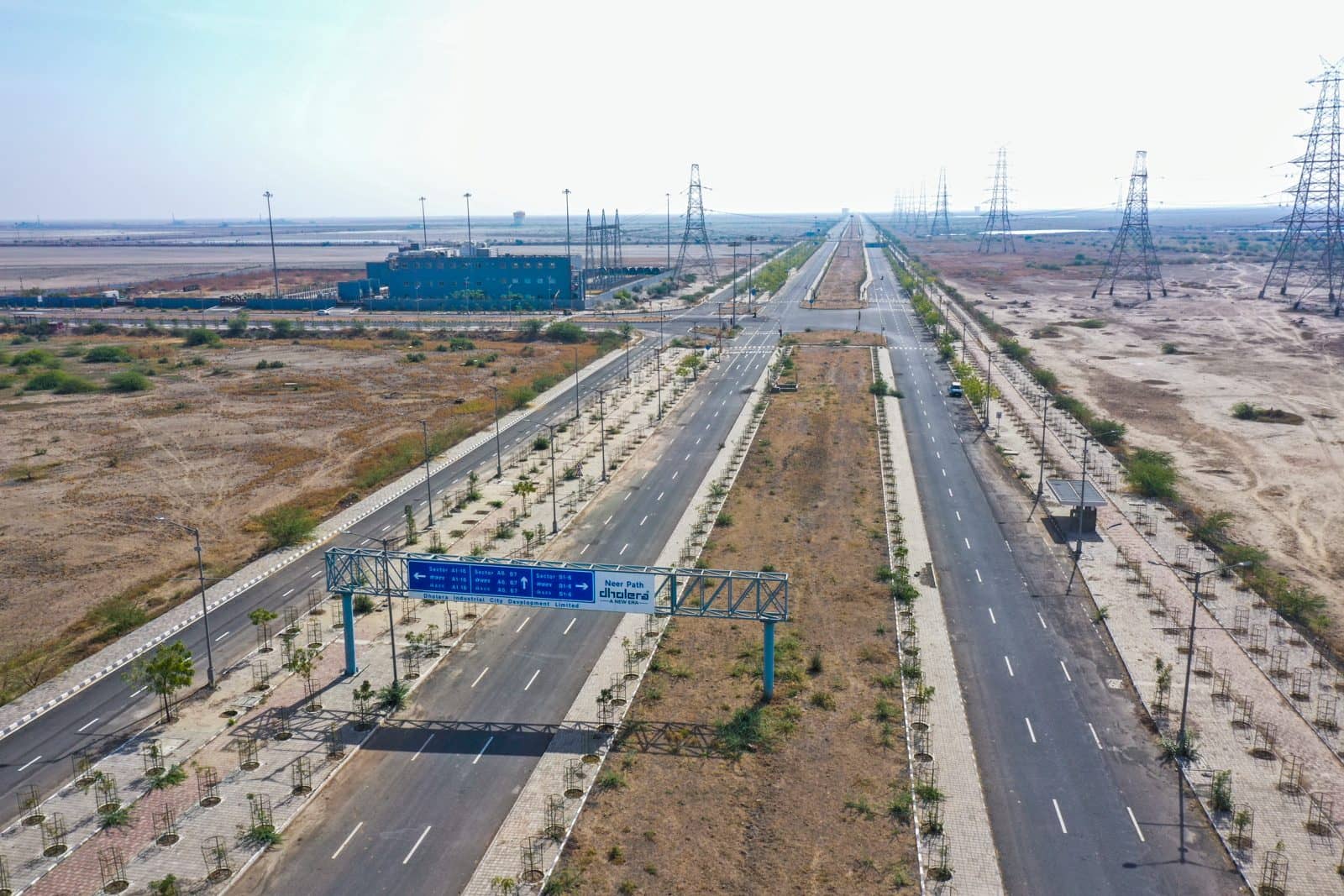
Dholera exists because of freight. The whole Delhi–Mumbai Industrial Corridor rests on the Western Dedicated Freight Corridor (DFC), and Dholera's long-term industrial case assumes efficient goods movement to ports and markets. A passenger semi-high-speed rail line to Dholera was approved in May 2026, while a dedicated freight spur to the site is referenced in planning material but its construction status is not confirmed from primary sources.
Dholera did not begin as a city. It began as a point on a freight line. To understand the region's rail story you have to separate three things that are routinely blurred together: the Western Dedicated Freight Corridor that gave the corridor its logic, the passenger semi-high-speed line approved in 2026, and a dedicated freight spur to Dholera whose status is genuinely uncertain.
Corridor spine
Western Dedicated Freight Corridor (DFC)
Passenger rail
Ahmedabad/Sabarmati–Dholera, approved May 2026
Freight spur to site
Referenced in planning; status not confirmed
Freight rationale
Cheaper goods movement to ports and markets
The freight logic behind Dholera
In the mid-2000s India and Japan agreed to build the roughly 1,500-km Delhi–Mumbai Industrial Corridor, anchored on a new Western Dedicated Freight Corridor. The idea was straightforward: a dedicated freight railway would cut the cost and time of moving goods across western India, and along that spine a series of new industrial cities would capture the manufacturing and urbanisation that cheaper logistics would unlock. Dholera was designated the largest of the corridor's nodes and became its flagship project.
The passenger semi-high-speed line
The most concrete rail development is a passenger line, not a freight one. In May 2026 the Cabinet Committee on Economic Affairs approved a semi-high-speed rail project connecting Ahmedabad and Sabarmati to Dholera SIR, the Dholera airport and Lothal.
Parameter
Reported value
New line
~134 km
Cost
~Rs 20,667 crore
Design speed
220 km/h
Operating speed
200 km/h
Target time
Sabarmati–Dholera ~48 minutes
Completion
2030–31 (target)
The freight spur: planned, status unconfirmed
References to a Bhimnath–Dholera freight line and to dedicated-corridor connectivity appear in planning material and a 2025 state review. However, the current construction status of a Dholera freight spur could not be confirmed from primary sources. The honest treatment is therefore "planned, status unconfirmed" rather than a delivered milestone — one of several places where marketing literature is more confident than the evidence warrants.
How it fits the wider picture
Rail sits alongside road and air. The Ahmedabad–Dholera Expressway opened in March 2026, and the airport is targeting a late-2026 window. Efficient freight rail is the long-term backbone of Dholera's industrial case — the semiconductor fab and any future data-centre and manufacturing cluster ultimately depend on moving goods cheaply — but the delivered rail facts today are the approved passenger line and the corridor concept, not an operating freight spur.
Frequently asked questions
What is the DFC and how does it relate to Dholera?
The Western Dedicated Freight Corridor is the freight railway spine of the Delhi–Mumbai Industrial Corridor. Dholera was conceived as an industrial node along that corridor, whose case rests on efficient freight movement to ports and markets.
Does Dholera have a dedicated freight rail line yet?
A Bhimnath–Dholera freight line and dedicated-corridor connectivity are referenced in planning material, but the construction status of a Dholera freight spur is not confirmed from primary sources. Treat it as planned, not delivered.
What rail link to Dholera is actually approved?
A semi-high-speed passenger line from Ahmedabad/Sabarmati to Dholera, the airport and Lothal, approved in May 2026 — about 134 km, reported at Rs 20,667 crore, with a 2030–31 completion target.
How is Dholera connected today?
By road, via the Ahmedabad–Dholera Expressway (open since March 2026, about a 45-minute drive). Rail is approved but not built, and the airport is under construction.
4.Sarkhedi, B. (2026) Dholera SIR: A Comprehensive Review, 2006 to 2026 (working paper)
Figures are dated and attributed; targets are distinguished from delivered facts. Verify time-sensitive figures against current official sources before relying on them.